
About the leopard
-
General information

Known worldwide for its fur and mysterious nature, the endangered snow leopard (Panthera uncia) inhabits the rugged, high mountains of Central Asia. Snow leopards are perfectly adapted to the cold, desolate, and barren highlands, but threats from human activity are threatening their future. Despite their range spanning more than 2 million km², scientists estimate that there are only 3,920 to 6,390 snow leopards left in the wild.
Biological features of the snow leopard
Lone Traveler: The snow leopard usually lives alone and is a very difficult and secretive animal to spot.
Crepuscular: Dawn and dusk are the most active times for this cat.
Home range: Some snow leopards have home ranges of up to 1,000 square kilometers.
Single mothers: Female leopards raise and raise their cubs (pups) completely alone for about 18 months.
Cold and dry: Snow leopards live mainly in dry, arid, mountainous areas with poor vegetation cover.
Peaceful: Snow leopards are known for not attacking or showing aggression towards humans.
Predator: The main prey of this cat family is ibex, argali, and blue sheep.
Scientific nomenclature and origin
Panthera uncia (Formerly Uncia uncia): Its species name, Uncia, comes from the Old French word once, which was originally used to refer to the Eurasian lynx. As a result, the snow leopard is sometimes called an "ounce" in English.
The snow leopard is known by many different names in its native lands, including:
Mongolia: Leopard
Division : Barys (Bars / Barys)
Hirgis: Leopard
In Tibet: Zigsa
Ladakh (India): Shan
Pashtun (Afghanistan, Pakistan): Wāwrīn pṛāng
Dari (Afghanistan): پلنگ برفی (Palang-e barfi)
Hindi, Urdu: बरफानी चीता (Barfānī chītā)
Sanskrit, Hindi: हिम तेन्दुा (Him tendua)
Physical characteristics
Body size
Height at the withers: 55 – 65 cm (22 – 26 inches)
Body length 90 – 115 cm (36 – 44 inches)
Tail length: Approximately 100 cm (40 inches)
Adapted to cold climates
The snow leopard is remarkably well-adapted to its natural environment.
Natural snowshoes: Its unusually large paws prevent it from getting stuck in the snow and act like dedicated snowshoes.

Round and short ears reduce body heat loss. The wide and short nasal cavity also serves to trap cold outside air before it reaches the lungs.
This feline has short, powerful front legs and relatively long hind legs, which give them the power to leap distances of up to 10 meters (30 feet) in a single bound.
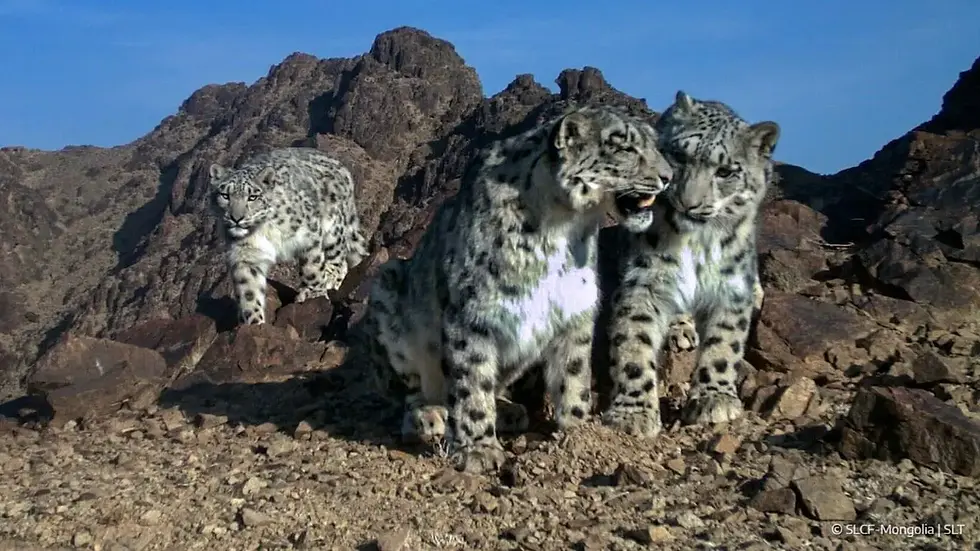
Its gray-white fur with dark spots and ring patterns provides excellent camouflage among rocks and snow.
The very long tail not only helps it balance when walking on rocky terrain, but it also serves as a blanket to wrap around itself for extra warmth when sleeping.
Behavior
Shy and secretive: Snow leopards are very shy and secretive animals, known for preferring to live alone.
Nocturnal: They are most active at dawn and dusk, and scientists call this a "crepuscular activity pattern."
Patrolling their territory: They regularly inspect and patrol their territory, which covers hundreds of square kilometers.
Family life: Male and female leopards are only seen together for a short time during mating season, or when the mother leopard is with her cubs.
Independence period: At approximately 2 years of age, the cubs leave their mother and begin their independent lives to seek their own territory.
Scent marking: Snow leopards use scent markings in the wild to communicate with each other. They mark their territory or search for mates by digging with their hind legs or spraying urine on rocks.
The leopard that can't roar: Snow leopards, like other big cats, can make sounds such as snarls, meows, hisses, growls, groans, and howls. However, due to the anatomy of their throats, they cannot roar, and instead make a non-aggressive, purring sound called a "chuff."
Safe for humans: Snow leopards are not aggressive towards humans. There is no officially confirmed case of a snow leopard attacking a human in history. Even if they are stopped or disturbed while feeding, they prefer to run away rather than attack and protect their prey.
d.Life cycle
The mating season for snow leopards lasts from January to mid-March. During this time, male and female leopards travel together for several days and breed.
Birth: Female leopards usually carry their pregnancy for 93 to 110 days, then retreat to a safe, sheltered cave or den and give birth to their cubs in June or July.
Caring for: A caring mother leopard raises her cubs alone, providing them with food and shelter and protecting them from danger.
Growth and Life Cycle of Insects
Snow leopard cubs grow very quickly.
Birth: The young are very small and defenseless at birth, and do not open their eyes for the first time until they are about 7 days old.
2 months old: Babies are ready to start eating solid foods (meat).
3 months old: They begin to follow their mother and learn important life behaviors, such as hunting.
18–22 months: Separates from mother and transitions to fully independent life.
Sexual maturity: Limited data in the wild suggest that female leopards are ready to give birth to their first cubs at the age of 3, while males reach sexual maturity at the age of 4.
Lifespan: Domesticated or zoo-raised snow leopards have been known to live up to 22 years. However, life in the wild is much harsher, and their average lifespan is usually 10 to 12 years.
-
Edible food
Diet Depends on Location: The diet of snow leopards varies depending on the region they live in, but they usually hunt mainly wild sheep and goats.
Top 3 Prey: The snow leopard's top three prey items are the blue sheep (also known as the baral), the Asiatic ibex (a large wild goat), and the argali (another species of wild sheep).
Key Habitat Factors: The abundance of wildlife and food in an area is the most important factor determining whether a snow leopard is suitable for living there.
Serene feeding: Snow leopards eat their prey very slowly, usually over a period of 3 to 4 days. During this time, they stay close to their prey to protect it from scavengers such as vultures and crows, eating and scraping the carcass every few hours until the carcass is bare. On average, they hunt one large animal every 8 to 10 days.
Gender differences: There are slight differences in the diet and hunting habits of male and female snow leopards.
Opportunistic predators: They hunt according to the situation and sometimes attack livestock (sheep, goats, horses or yak calves), especially those that have been abandoned or left behind in the pasture.
Attacks on livestock enclosures: In some areas, snow leopards have been known to enter livestock enclosures and kill large numbers of animals at once. Attacks on livestock are increasing as wildlife populations decline and hunting becomes more difficult during the harsh winter months.
Habitat
Snow leopards inhabit the majestic mountains of Central Asia. Their range covers an area of 2 million km² (about the size of Greenland or Mexico), but today there are only an estimated 3,920 to 6,390 snow leopards left in the wild.
12 countries covered: The snow leopard's habitat spans 12 countries: Afghanistan, Bhutan, China, India, Kazakhstan, Kyrgyzstan, Mongolia, Nepal, Pakistan, Russia, Tajikistan, and Uzbekistan.
Conservation focus: China accounts for up to 60 percent of the total snow leopard habitat, making it a key country with the greatest impact on global conservation efforts for this species.
Altitude differences: In the Himalayas, snow leopards are usually found at altitudes of 3,000 to 5,400 meters above sea level. In Mongolia and Russia, they are found at relatively low altitudes, starting at an altitude of 1,000 meters.
Climate: The high mountain regions where snow leopards live are cold and dry, with only sparse grass and low shrubs growing on the steep slopes.
Terrain: They prefer rugged terrain with many obstacles, such as cliffs, cliffs, and canyons. This topography gives them a clear view of their prey and provides perfect camouflage to sneak up on them without being noticed.
Territory and Migration
Each snow leopard has its own distinct territory. They are not as aggressive as other felines, but male leopards tend to defend their own exclusive territories. However, their territories may overlap with those of females.
The size of the territory required by each snow leopard varies depending on its natural environment. According to scientists, this is directly related to the abundance of food. In areas where prey is abundant, leopards' home ranges can be as small as 30–65 km². However, in areas where food is scarce, they need to expand their hunting grounds, and their home ranges can exceed 1,000 km².
Snow leopards are nomadic and, while hunting, they constantly patrol their territory, leaving marks to deter other leopards from entering. They often travel along mountain ridges and cliffs, choosing a high position to rest and sleep, with a good view of their surroundings.
Snow leopards are known for their ability to travel long distances, leaving their home ranges behind them in a short period of time. Using modern habitat mapping technology, scientists have recorded a snow leopard traveling 43.5 kilometers (27 miles) across vast desert in just one night.
Interesting facts